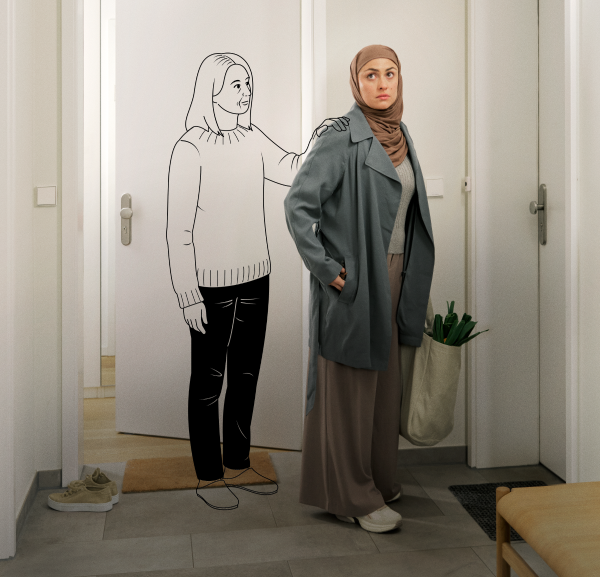
How can I recognise domestic abuse?
Even though it may look that way in movies, domestic abuse often doesn’t manifest as bruises on the wrists or scrapes on the face. Domestic abuse takes many different forms, which is why there are rarely clear-cut signs. For everything listed here, the following applies: None of these signs are clear proof that someone is experiencing abuse. But they can be an initial indication that a person is affected, especially if you notice several signs. Trust your gut.
What counts as domestic abuse?
Domestic abuse takes many forms. These forms of abuse include:
| Form of abuse | Examples |
|---|---|
| Physical violence | Hitting, kicking, choking, restraining, hair-pulling, confinement, forced sexual acts |
| Psychological and emotional abuse | Insults, humiliation, threats, ignoring and “withholding love,” constant criticism, belittling, including in front of others |
| Structural and economic abuse | Control over money (e.g., controlling or denying access to accounts) Control over documents (e.g., keeping IDs or birth certificates under lock and key) Control over mobility (e.g., taking away a driver’s license, hiding car keys, or damaging a bicycle) Control over time and personal life planning (e.g. restricting or prohibiting meetings with friends and family, denying access to hobbies) |
| Digital abuse | Stalking using apps and spyware, data tracking Defamatory posts on social media Publishing intimate/sexual images or videos (including threatening to publish them) |
What are the signs that someone may be experiencing abuse?
- Withdrawal and isolation: Your friend never has time to meet up with you anymore and is constantly coming up with new excuses? Does your coworker no longer go to the gym or her pottery class? Social withdrawal is often one of the first, subtle warning signs that a person is experiencing abuse in their personal life.
- Changes in behaviour: Your neighbour, who’s usually so sociable, hardly ever leaves the house anymore? Is a friend who’s usually calm and relaxed now jumpy and agitated? Insecurity, apathy, or withdrawal can be signs that someone is experiencing abuse—especially if their behaviour has changed.
- Visible injuries: Physical violence can leave visible marks such as bruises, scrapes, burns, or strangulation marks. Often, people affected have a seemingly plausible explanation ready when you ask them about their injuries. Note: there are no “typical injuries” associated with domestic abuse! However, especially if you repeatedly notice similar injuries over a longer period of time, this can be a sign.
What are some signs that a person is committing abuse?
- Constant availability for the partner: You can hardly ever reach your best friend, but when their partner calls, they always answer the phone? Even when you’re out doing something together, do they immediately reply to every message? Perpetrators often control the behaviour of the person affected, for example, by making them constantly tell their partner what they are doing and who they are with.
- Changes in the partner’s behaviour: Does your coworker’s partner constantly pick them up from the office, even though they can drive themselves? Is your neighbour's husband jealous of everyone she spends time with, accusing and making insinuations about her? Domestic abuse is also evident in the perpetrator’s behaviour.
How can I recognise complex patterns of abuse?
Domestic abuse usually occurs within a (former) relationship. Perpetrators manipulate the affected person over a long period of time, exploiting the close personal bond between them. These patterns of behaviour are typical:
- Gaslighting: The perpetrator manipulates the affected person by distorting the truth and denying facts. The affected person begins to doubt their own perceptions, memories or sanity.
- Blame-shifting: The perpetrator convinces the affected person that they are responsible for the abuse. The affected person downplays the other person’s abuse and blames themselves (for example, with statements like “I wasn’t paying attention” or “I provoked him”).
- Coercive Control: The perpetrator restricts the affected person’s daily life through a systematic pattern of various forms of abuse. In this way, the perpetrator undermines the affected person’s autonomy and forces complete dependence. The perpetrator exercises control in all areas of life and isolates the affected person.
- Trauma Bonding: After an escalation of abuse, the perpetrator shows remorse and showers the affected person with supposedly loving gestures (love bombing). Through the alternating phases of abuse and reward, the affected person then associates the perpetrator with feelings of rescue and relief.
How can I help people affected by domestic abuse?
Have you noticed something that gives you strong someone around you is experiencing domestic abuse? If so, you may now be afraid, feel overwhelmed, or not know what to do next. The good news: there are many concrete steps you can take to help those affected.
1. Preparation: Finding the right setting
- Try to have this conversation in a safe environment. Only talk about your concerns if you are absolutely sure you are alone with the person and no one else can hear you. Make sure that the partner, family and others aren’t listening.
- Take plenty of time. People who experience domestic abuse often feel shame, fear or even guilt. So don’t have this conversation in passing. Be empathetic, stay calm and let them know that you’re there to help.
- Be cautious with digital communication. Only express your suspicions in a face-to-face conversation, not via WhatsApp, email, or social media. Perpetrators often monitor the smartphones and computers of people affected.
2. Conducting the Conversation: Using "I" Messages
- Don't judge. It may seem counterintuitive, but even if you mean well, a thoughtless remark can put the person affected under even more pressure.
- Don’t make accusations. Direct accusations against the partner (“Your husband beats you, doesn’t he!”) intensify shame and often lead to defensiveness. Describe your own observations and feelings:
- “I’ve noticed that you’ve become very quiet lately. I’m worried about you. How are you really doing?”
- “I saw that you have bruises on your arm. You don’t have to tell me anything you don’t want to. But I’m here for you if you want to talk.”
- “Lately, I’ve gotten the feeling that you get scared when your partner calls. Is that true?”
- Don’t offer any advice just yet. That just increases the pressure. Instead, let the person affected know that they can talk to you about anything.
3. Listening and responding: What people affected need
- Believe the person affected. Do not question their account. Statements like “I can’t even imagine that—he’s always so nice” are hurtful and can further enable perpetrator strategies such as instilling doubt.
- Do not blame the person affected. Abuse is never the affected person’s fault. No matter what happened before.
- Allow for quiet moments. It takes a lot of strength to talk about experiences of abuse. Silence is a natural part of a conversation like this. Do not rush to fill the silence.
- Important things you can say:
- “I’m sorry that this happened to you.”
- “It’s not your fault.”
- “It’s brave of you to tell me this.”
4. Here's how you can help
- Have information about counselling services on hand. Write down the number for the Violence against Women Helpline (116 016), and look up women’s refuges and support organizations in the area. Suggest calling the helpline together or making an appointment for counselling.
- Offer a safe place, such as a place to sleep at your home, if you know the person well.
- Stay in touch with the affected person’s children. When one parent is abusive toward the other, it takes a particularly heavy toll on the children. If they directly witness this abuse, it can put their welfare at risk. A safe person to turn to outside the household provides children with much-needed stability in this stressful situation.
- Accompany the affected person to a counselling centre, the hospital, or the police. Offer to watch the children during appointments. People affected who don’t feel alone are better able to seek help.
- Never confront the abuser on your own. In the worst-case scenario, you could put the affected person in even greater danger.
Hand signals and codes: How to help strangers
Not everyone affected by abuse has someone close to them that they can trust. There are various signals that allow anyone experiencing abuse to safely and discreetly indicate that they need help and protection. Be observant and show moral courage by paying attention to these signals.
The Signal for Help:
This international hand signal (Signal for Help * ) is a silent call for help for people in emergency situations. A person who displays this sign is signaling: I need immediate help. Here’s how it works:
- A person raises a hand with the palm facing forward toward another person.
- The person tucks their thumb into their palm.
- The person encloses their thumb with their remaining four fingers, as if “trapping” it.
If you see this hand signal, stay calm. If possible, speak to the person discreetly. In case of immediate danger, do not hesitate to call 110.
* Developed in 2020 by the Canadian Women’s Foundation
Codes for abuse
In addition to the international hand signal, there are various codes that people can use to discreetly indicate that they are experiencing abuse, are in distress, or feel threatened.
- Luisa ist hier: This code is particularly well-known in nightlife settings. It signals to staff in bars and clubs that a person wants to be taken to safety. *
- Panama: Festivals and some football clubs use this word as an emergency code, for example in the question, “How do I get to Panama?”. **
- Maske 19: With this code word, people affected can alert pharmacy staff that they are experiencing domestic abuse. ***
* The code “Luisa ist hier” was developed by Frauen-Notruf Münster e. V.
** “Panama” as a code word for emergency situations was originally developed for the Hurricane Music Festival.
*** “Maske 19” was developed during the COVID-19 pandemic by the Instituto Canario de Igualdad (Canary Islands Institute for Equality, ICI) in Spain.
How do I talk to someone if I suspect they are experiencing domestic abuse?
What can I do if the person affected doesn't want to accept help?
Can I call the police if I suspect that someone is in immediate danger?
What else can I do to help in practical ways?
Where can I get support if I know someone affected by domestic abuse?
The Violence against Women Helpline (116 016) and the Help Hotline for Violence Against Men (0800 1239900) also provide counselling to people close to those affected—free of charge and anonymously. The Nummer gegen Kummer (116 111) provides counselling for children and young people. Local women’s refuges and intervention centres also offer support and advice to people supporting someone affected.